Data Catalog Market – By (Component - Forecast(2025 - 2031)
Data Catalog Market Overview:
Data Catalog Market size is estimated to reach $2700 Million by 2030, growing at a CAGR of 22% during the forecast period 2024-2030. The Data Catalog market plays a pivotal role in helping organizations efficiently manage and utilize their vast data assets. Data catalogs are essential tools that enable businesses to discover, classify, and govern data across diverse sources, thereby driving improved decision-making and compliance with regulatory standards. The market's growth is driven by the rapid adoption of multi-cloud environments, increasing regulatory requirements, and the growing demand for self-service analytics among enterprises. Additionally, advancements in AI and machine learning are significantly enhancing the capabilities of modern data catalogs, enabling automated metadata management and advanced search functionalities. However, challenges such as integration with legacy systems and high deployment costs pose barriers to market growth. Despite these challenges, increasing digital transformation initiatives and the rising importance of data-driven strategies are expected to propel the market forward in the coming years. A significant trend in the Data Catalog market is its growing application in supporting data governance frameworks. Organizations are leveraging data catalogs to improve data quality, enhance metadata management, and streamline compliance efforts. For example, enterprises operating in heavily regulated sectors such as finance and healthcare are deploying data catalogs to meet stringent requirements like GDPR and HIPAA. These tools help in identifying and securing sensitive data, thereby reducing risks associated with non-compliance. The automation capabilities of modern data catalogs, such as tagging and data lineage tracking, further simplify governance processes, allowing businesses to focus on strategic objectives. As regulatory landscapes become increasingly complex, the reliance on data catalogs as a core governance tool is expected to intensify, driving market growth.
Another noteworthy trend is the increased use of AI and machine learning in data catalog solutions. Advanced data catalogs now incorporate AI-driven features that enable predictive analytics, smart recommendations, and natural language processing for enhanced user experience. These capabilities significantly reduce the time required to discover and classify data, improving operational efficiency. For instance, AI-enabled catalogs can automatically detect and flag anomalies in data usage patterns, aiding in risk mitigation. Additionally, machine learning algorithms enhance metadata accuracy by learning from user behaviors and refining search functionalities over time. As enterprises seek more intelligent and intuitive solutions, the integration of AI and machine learning in data catalogs is poised to become a cornerstone of innovation in this market.
Market Snapshot:
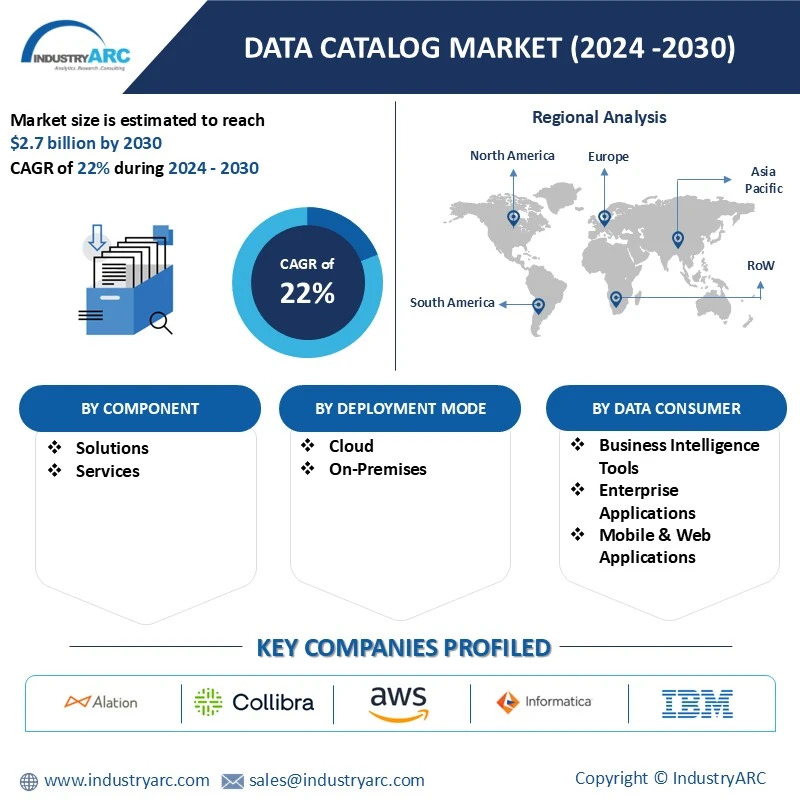
Data Catalog Market - Report Coverage:
The “Data Catalog Market Report - Forecast (2024-2030)” by IndustryARC, covers an in-depth analysis of the following segments in the Data Catalog Market.
Attribute | Segment |
Component |
|
By Deployment Mode |
|
By Data Consumer |
|
By Enterprise Size |
|
By End Use Industry |
|
By Geography |
|
COVID-19 / Ukraine Crisis - Impact Analysis:
- The COVID-19 pandemic significantly influenced the Data Catalog market, presenting a dual impact of challenges and opportunities. Initially, disruptions in IT infrastructure projects and budget reallocations toward pandemic-related priorities slowed down the adoption of data catalog solutions. Organizations postponed digital transformation initiatives, leading to a temporary decline in demand for data management tools.
- The Russia-Ukraine conflict further complicated the Data Catalog market by impacting global IT supply chains and economic stability. Both nations are key contributors to the technology sector, particularly in software development and IT outsourcing services. The conflict disrupted these resources, creating delays in software development and integration services for data catalogs. Additionally, increased cybersecurity concerns stemming from geopolitical tensions led organizations to prioritize data security features in catalog solutions, driving a shift in product demand.
Key Takeaways:
- Cloud Deployment Mode Witnesses Rapid Expansion
The cloud deployment mode is the fastest-growing segment in the Data Catalog market. As organizations continue to prioritize scalability, flexibility, and cost-efficiency, cloud-based solutions have become the go-to option for managing vast amounts of data. The growing adoption of multi-cloud environments, combined with the shift towards remote and hybrid work models, further accelerates the demand for cloud-based data catalogs. Moreover, cloud providers have enhanced their security frameworks, addressing concerns about data privacy and governance, which has bolstered trust in cloud platforms. The seamless integration of data catalogs with various cloud services enables businesses to maintain high-quality data management while reducing operational costs. This trend is especially significant as enterprises increasingly move away from on-premises solutions in favor of cloud-based alternatives.
- Business Intelligence Tools: Leading Data Consumer Segment
Business Intelligence (BI) tools remain the largest consumer of data catalogs in the market. As organizations strive to make data-driven decisions, BI tools have become crucial for analyzing and interpreting complex data sets. Data catalogs enable seamless integration with these tools, ensuring that users have easy access to accurate and well-governed data. The growing emphasis on real-time analytics, data visualization, and predictive insights has made BI tools indispensable for businesses looking to stay competitive. Furthermore, the increased demand for self-service analytics among business users requires a well-organized data catalog to allow for efficient data discovery and governance. As businesses continue to embrace BI tools to improve decision-making and operational efficiencies, the need for comprehensive data catalogs that support these tools will only increase.
- Regulatory Compliance Driving Market Growth
The rising importance of regulatory compliance is significantly driving growth in the Data Catalog market. With the global tightening of data privacy laws such as GDPR, CCPA, and various local regulations, businesses must ensure that their data is managed in a compliant and auditable manner. Data catalogs play a crucial role by providing transparent data lineage, allowing companies to trace data flows and ensure that all processes are in line with legal requirements. Additionally, industries such as healthcare, finance, and retail, which handle sensitive customer information, increasingly rely on data catalogs to adhere to these complex regulations. By helping organizations enforce data governance policies and manage access control, data catalogs mitigate the risk of non-compliance and the penalties associated with it.
- Integration Complexity Poses Challenges
Despite the rapid growth of the Data Catalog market, integration complexity remains a significant challenge for many organizations. Data catalogs need to integrate seamlessly with a wide array of data sources, enterprise systems, and legacy infrastructures, which can be time-consuming and technically demanding. Businesses often struggle to align new data catalog solutions with their existing tools and data pipelines, leading to delays in implementation and additional costs. Furthermore, organizations that lack the necessary technical expertise may face difficulties in optimizing these tools to their full potential. This challenge is particularly acute in industries with complex IT environments or large amounts of unstructured data. To overcome these barriers, data catalog providers need to offer user-friendly solutions, provide robust integration support, and deliver training programs to help organizations maximize the value of their investments.
- Healthcare Industry Driving Adoption
The healthcare industry is rapidly embracing data catalog solutions due to the growing volume and complexity of healthcare data. With the rise of electronic health records (EHRs), medical research, and patient-centric care models, healthcare organizations need efficient data management systems to ensure data is easily accessible, accurate, and compliant with regulations. Data catalogs provide healthcare providers with a centralized repository that enables easy discovery, management, and governance of medical data. They also facilitate data interoperability, enabling seamless data exchange across various systems, such as EHRs, clinical trial databases, and patient registries. The increasing focus on personalized medicine, which requires integrating diverse data sources to create patient-specific treatment plans, further drives the demand for data catalogs. Additionally, the need for robust data security and compliance with healthcare regulations like HIPAA increases the reliance on data catalogs in this sector.
- Asia-Pacific: Fastest Growing Region
Asia-Pacific is emerging as the fastest-growing region for the Data Catalog market. The region’s rapid digital transformation, coupled with significant investments in IT infrastructure, is driving increased demand for data management solutions. Countries such as China, India, and Japan are witnessing a surge in data generation, particularly in industries such as healthcare, e-commerce, and manufacturing, creating a need for effective data cataloging. Additionally, Asia-Pacific governments are prioritizing digitalization efforts, with many implementing smart city projects and promoting advanced technologies such as AI and IoT. This increase in data complexity and volume has made data catalogs a crucial component for businesses seeking to manage their data assets efficiently. The rising focus on cloud adoption and regulatory compliance further contributes to the growth of the data catalog market in the region. Moreover, the availability of low-cost, scalable cloud solutions and the growing number of data-centric startups in the region are expected to keep fueling market expansion.
Key Market Players:
Product launches, approvals, patents and events, acquisitions, partnerships and collaborations are key strategies adopted by players in the Data Catalog Market. The top 10 companies in this industry are listed below:
- IBM
- Informatica
- Amazon Web Services
- Collibra
- Alation
- Microsoft
- TIBCO Software
- Alteryx
- Dataedo Sp. z o.o.
- Cloudera, Inc.
- Oracle
Scope of the Report:
Report Metric | Details |
Base Year Considered | 2023 |
Forecast Period | 2024–2030 |
CAGR | 22% |
Market Size in 2030 | $ 2.7 billion |
Segments Covered | Type, Design Type, Application and Region |
Geographies Covered | North America, South America, Europe, APAC, RoW |
Key Market Players |
|


Comments
Post a Comment