Solar Thermal Power Market - Forecast(2025 - 2031)
Solar Thermal Power Market Overview:
Solar Thermal Power Market Size is valued at $34.1 Billion by 2030 and is anticipated to grow at a CAGR of 4.5% during the forecast period 2024 -2030. Solar thermal power harnesses sunlight to generate thermal energy, which is then converted into electricity. This technology uses solar collectors to absorb heat, usually employing fluids to transfer this heat to a steam generator. Unlike photovoltaic systems, solar thermal focuses on heat rather than electricity.
Recent trends indicate a growing interest in hybrid systems, declining costs, and increased investment in concentrated solar power (CSP) technologies, enhancing efficiency and storage capabilities.
Market Snapshot:
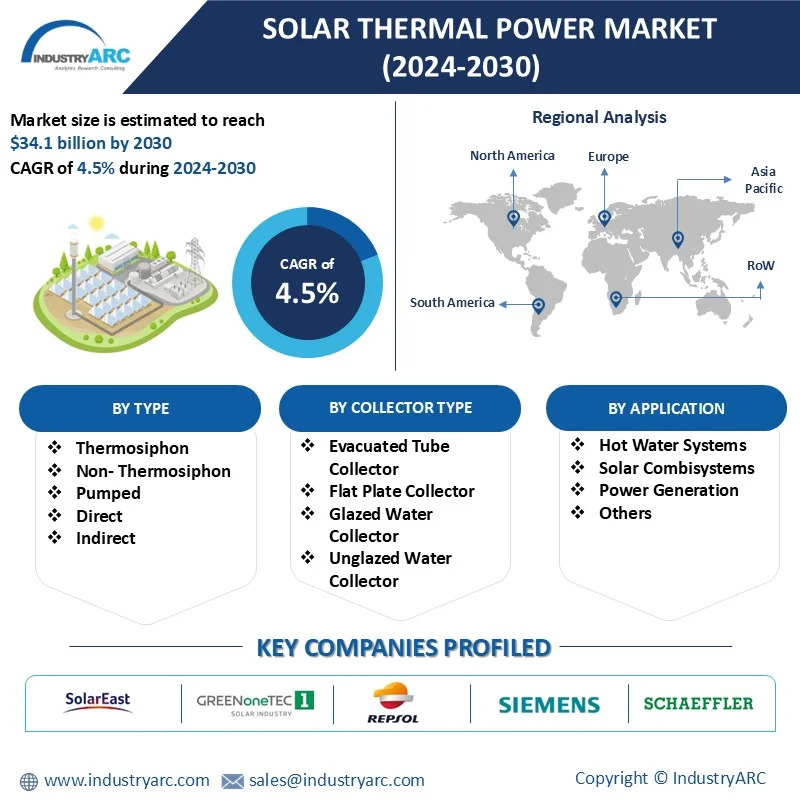
Solar Thermal Power Market - Report Coverage:
The “Solar Thermal Power Market Report - Forecast (2024-2030)” by IndustryARC, covers an in-depth analysis of the following segments in the Solar Thermal Power Market.
| |
| |
|
COVID-19 / Ukraine Crisis - Impact Analysis:
• The COVID-19 pandemic significantly impacted the solar thermal power market, causing delays in project timelines and supply chain disruptions. Lockdowns and restrictions hindered construction activities, leading to postponed installations and reduced investments. Demand fluctuations affected financing and operational costs. However, the crisis also accelerated the shift towards renewable energy, as governments sought sustainable recovery strategies. Increased focus on energy independence boosted interest in solar thermal solutions for heating and power generation. Overall, while the pandemic posed challenges, it also highlighted the resilience and potential growth of the solar thermal sector in a transitioning energy landscape.
• The Russia-Ukraine War has had a profound impact on the solar thermal power market, primarily by exacerbating energy security concerns across Europe and beyond. Rising fossil fuel prices and supply chain disruptions prompted countries to accelerate their transition to renewable energy sources, including solar thermal systems. This shift aimed to reduce dependence on imported energy, driving investments in solar infrastructure. Additionally, heightened geopolitical tensions emphasized the need for stable, sustainable energy solutions. Despite challenges in raw material procurement and increased costs, the war has ultimately reinforced the importance of solar thermal technology in achieving energy independence and sustainability goals.
Key Takeaways:
• Evacuated Tube Collector Holds Largest Market Share in the Solar Thermal Power Market
In 2023, Evacuated Tube Collector held a significant position in the Solar Thermal Power market, securing a notable 71% market share. The Evacuated Tube Collector (ETC) segment is a leading technology in the solar thermal power market, driven by its superior efficiency and versatility. ETCs are designed to minimize heat loss through vacuum insulation, making them ideal for water heating in residential, commercial, and industrial sectors. Their ability to perform efficiently in cold and cloudy climates enhances global adoption. Increasing demand for sustainable energy solutions, coupled with supportive government policies and incentives, is fueling market growth. The ETC market is projected to grow particularly in regions like Asia-Pacific and Europe, where solar energy deployment is accelerating.
• Growing Demand for Solar Thermal Power Due to Growing Energy Demand
Global energy demand is projected to grow at an annual rate of 1.3% until 2040, with electricity demand rising even faster at an average of 3.4% annually through 2026. This surge is driven by population growth, urbanization, and the expanding electrification of sectors like residential, transport, and data centers, especially in advanced economies and China. The share of electricity in final energy consumption has already increased from 18% in 2015 to 20% in 2023. To meet this growing demand while achieving global decarbonization targets, solar thermal power emerges as a key solution. With its sustainable energy production, it is becoming an increasingly attractive alternative to traditional power sources. Countries like Spain, the USA, and Australia are investing heavily in solar thermal plants to reduce carbon footprints. Government policies such as feed-in tariffs and tax rebates further boost the adoption of renewable energy, supporting the growth of the solar thermal power market.
• Negative Impact on the Solar Thermal Power Market Due to High Initial Capital Costs
High capital costs present a significant challenge for the solar thermal power market, particularly for concentrated solar power (CSP) plants. In comparison to photovoltaic (PV) systems, CSP requires much higher upfront investment for installation and infrastructure. This cost disparity hinders large-scale adoption, even though CSP offers long-term benefits like energy storage compatibility. Despite recent projections indicating that CSP's capital expenditure (CAPEX) could decrease by 30% by 2030—from $6,280/kWe in 2020 to $4,379/kWe—CSP will still be more expensive than PV technology. This continued cost gap presents a barrier to expansion, particularly in regions such as the Middle East and North Africa, where financing gaps have delayed projects. As a result, CSP faces difficulties securing funding, limiting its competitiveness against cheaper, more widely available PV systems. These financial challenges must be addressed to unlock CSP’s potential for large-scale deployment.
Key Market Players:
Product launches, approvals, patents and events, acquisitions, partnerships and collaborations are key strategies adopted by players in the Solar Thermal Power Market. The top 10 companies in this industry are listed below:
1. Schaeffler AG
2. Siemens AG
3. Repsol
4. Greenonetec Solarindustrie GmbH
5. Solareast Holdings Co. Ltd.
6. BrightSource Energy
7. Sener
8. SCHOTT
9. BTE Solar Co. Ltd.
10. Linuo Ritter International Co. Ltd.
Scope of the Report:
Report Metric | Details |
Base Year Considered | 2023 |
Forecast Period | 2024-2030 |
CAGR | 4.5% |
Market Size in 2030 | $ 34.1 billion |
Segments Covered | By Type, By Collector Type, By Application, By End User, and By Region |
Regions Covered | North America (USA, Canada, and Mexico), Europe (UK, Germany, France, Italy, Netherlands, Spain, Russia, and Rest of Europe), Asia-Pacific (China, Japan, India, South Korea, Australia, Indonesia, Malaysia, and Rest of APAC), South America (Brazil, Argentina, Colombia, Chile, and Rest of South America), and Rest of the World (Middle East, and Africa). |
Key Market Players |
|



Comments
Post a Comment