Reverse Osmosis Membranes Market – By Material Type , By Filter Module , By Application , By End-Use Industry and By Geography - Opportunity Analysis & Industry Forecast, 2024-2030
Reverse Osmosis Membranes Market Overview
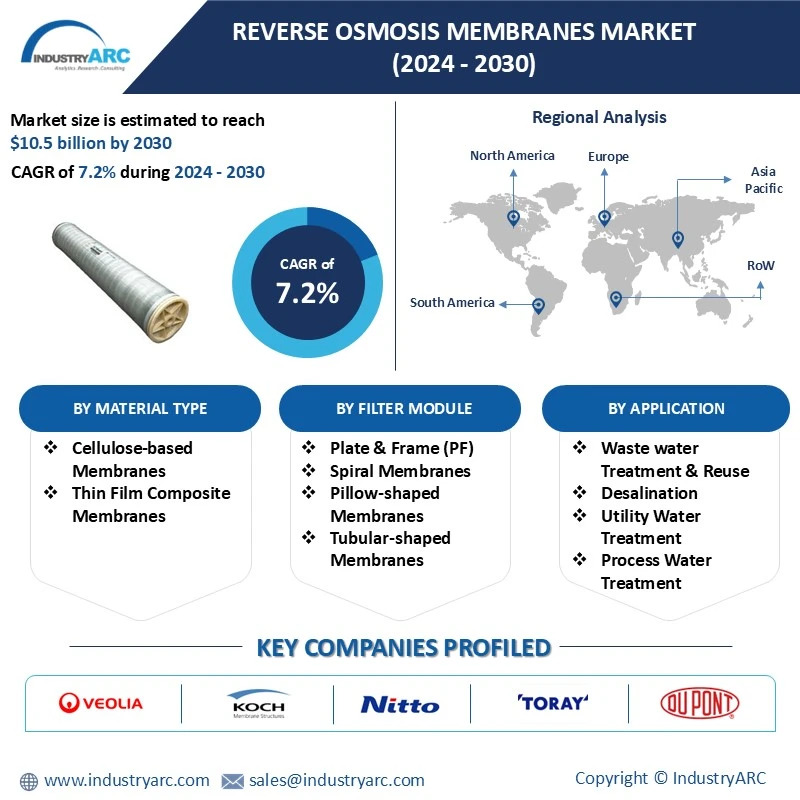
The global Reverse Osmosis Membranes market size is estimated to reach $10.5 billion by 2030, growing at a CAGR of 7.2% during the forecast period 2024-2030. Reverse osmosis is the process of applying pressure to overcome colligative properties. Osmotic pressure is directed by a thermodynamic parameter and a chemical difference of a solvent. The rising health concerns regarding safe drinking water, increasing water scarcity & government mandates requiring nanofiltration, activated carbon method and partially permeable membrane of industrial & municipal wastewater are driving the reverse osmosis market. Additionally, rising demand for packaged drinking water coupled with increased desalination of water for industrial as well as household purposes are expected to further drive the reverse osmosis membranes market share. The growing demand for clean water, industrial applications, water pollution control, advancements in RO technology, desalination projects, agricultural needs, urbanization in emerging economies, stringent environmental regulations, sustainability trends and supportive government initiatives also drive the market.
A notable trend in the reverse osmosis membranes market is antifouling membranes. These membranes are designed to resist fouling, a common problem that reduces membrane performance and requires frequent cleaning. Innovative surface modifications and coatings are being developed to enhance the antifouling properties of RO membranes. In November 2023, ZwitterCo, the advanced membrane technology company, announced the opening of its Early Access Program for the company's new brackish water reverse osmosis (BWRO) membranes. ZwitterCo's BWRO elements are the first organic fouling-immune brackish water membranes in the world that reduce cleaning frequency by as much as 90%, resulting in lower operational costs while delivering proven and reliable BWRO performance. Another trend is the adoption of thin film membranes. These membranes offer high performance and energy efficiency making them a popular choice for various applications.
Market Snapshot :
Reverse Osmosis Membranes Market - Report Coverage:
The “Reverse Osmosis Membranes Market Report - Forecast (2024-2030)” by IndustryARC, covers an in-depth analysis of the following segments in the Reverse Osmosis Membranes Market.
COVID-19 / Ukraine Crisis - Impact Analysis:
- The COVID-19 pandemic significantly impacted the reverse osmosis membranes market through supply chain disruptions, delays in production and increased raw material costs. Industrial demand declined as manufacturing and power generation sectors slowed down, while residential and healthcare sectors experienced growth due to heightened awareness of water quality and the need for ultrapure water.
- The Russia-Ukraine war affected the market by driving up energy prices which increased operational costs for energy-intensive desalination and RO systems. Supply chain disruptions due to sanctions and trade restrictions further delayed production and delivery. However, European nations and energy-stressed regions accelerated investments in advanced and energy-efficient water treatment technologies to enhance resilience and counter rising costs, creating new avenues for market growth.
Key Takeaways
Cellulose based Membranes are the Largest Segment
The Cellulose-based Membranes are the largest segment in the Reverse Osmosis Membranes market in 2023. This growth is fueled by the increasing demand for pure water & physical water treatment process. Cellulose acetate (CA) and cellulose triacetate (CTA) are the most common types of cellulose-based membranes. They offer excellent water permeability, good mechanical strength and good chemical resistance. Additionally, they are cost-effective making them a popular choice for a wide range of applications, including water treatment, desalination and food and beverage processing. In April 2024, Veolia Water Technologies and Alkhorayef Group formed a partnership to address the growing demand for advanced water solutions in Saudi Arabia. They will establish a Reverse Osmosis (RO) membrane production facility and technical center in the Kingdom, set to begin operations in 2026. The collaboration combines Veolia Water Technologies's expertise in RO membranes with Alkhorayef Group's local industry knowledge.
Desalination is the Largest Segment
In the Reverse Osmosis Membranes market, desalination is the largest application. The need for desalination is increasing mainly due to the increasing global water scarcity especially in arid and semi-arid regions. RO systems are effective in removing salts and other impurities from seawater making it suitable for drinking and irrigation. As per Applied Membranes, in desalination process sea water is forced against semi-permeable membranes under pressure in a continuous flow condition. The high salt content of sea water requires that the operating pressure for Reverse Osmosis must be between 60-70 bar. As the water permeates through the membrane most of the dissolved impurities removed and 99.5% of the total salt is removed. In May 2024, Veolia won a contract through its subsidiary Sidem to engineer and supply key technology for the Hassyan seawater desalination plant in Dubai, United Arab Emirates (UAE) for US$320 million. Commissioned by Dubai Electricity and Water Authority (DEWA) and ACWA Power, the plant will be the world’s second largest desalination plant based on reverse osmosis (RO) technology, and the largest desalination plant powered by solar energy.
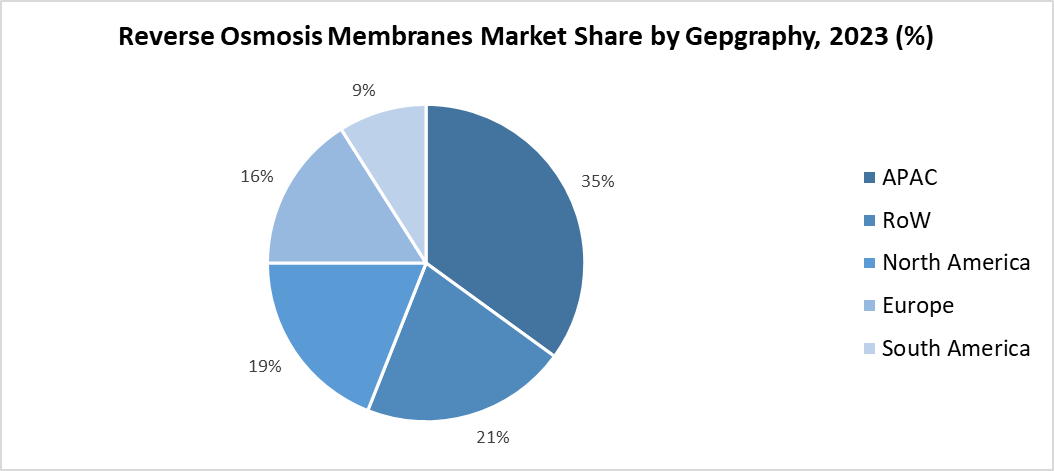
APAC Dominates the Market
Asia-Pacific dominates the reverse osmosis (RO) membranes market due to its water scarcity, rapid industrialization and increasing water scarcity. According to the United Nations World Water Development Report 2023, around 80% of people living under water stress live in Asia, particularly in northeast China, India and Pakistan. As per the Borgen Project, in the Philippines, a nation with a population of 115 million, 52% of families face limited access to clean water resources. The World Health Organization (WHO) reports that one in 10 citizens endure scarce water conditions, underscoring the urgency of addressing this crisis. Additionally, the water might be contaminated necessitating the usage of RO systems. In June 2024, Suez and construction company Jemco announced a collaboration to design, build, and operate a large-scale seawater reverse osmosis (SWRO) desalination plant in Metro Iloilo, Phillipines to address the region's critical drinking water shortage. Commissioned by Metro Pacific Investment Corporation, the plant is set to be the largest facility of its kind in the Philippines, producing approximately 66,500 cubic metres of water daily, supplying drinking water to nearly 50,000 households and the industrial water needs of a nearby power plant.
Increasing Demand for Safe Drinking Water Boosts the Market
Growing health concerns regarding safe drinking water among consumers are boosting the growth of the Reverse Osmosis Membranes market. Each year in the United States, waterborne pathogens cause an estimated 7.15 million illnesses, 118,000 hospitalizations, and 6,630 deaths, as per the CDC. Increasing adoption of water purifiers in homes and other public places, as well as rising consumer awareness about waterborne diseases, resulted in the adoption of reverse osmosis machines at homes and in public places. Reverse osmosis (RO) is increasingly recognized as an effective method for removing Per- and poly-fluoroalkyl substances (PFAS) from drinking water. PFAS, known as forever chemicals, persist in the environment and pose health risks, making their removal critical. RO, which uses a semipermeable membrane to separate impurities from water, has proven especially effective in eliminating both long- and short-chain PFAS compared to other methods like granular activated carbon (GAC) and ion exchange (IX).
High Energy Consumption to Hamper the Market
In large-scale applications like seawater desalination, where high pressure is required to push water through the semipermeable membrane, energy consumption is indeed a challenge. This energy demand can account for 30-50% of a plant's operational costs, making RO desalination expensive, especially in regions with high energy prices or limited renewable energy resources. Although energy recovery devices (ERDs) can capture and reuse some of the energy from the brine stream, they cannot fully eliminate the issue. Additionally, the reliance on fossil fuels for power exacerbates environmental concerns.
For more details on this report - Request for Sample
Key Market Players
Global Reverse Osmosis Membranes top 10 companies include:
- DuPont
- Toray Industries
- Koch Membrane Systems
- Nitto Denko Corporation
- Veolia Water Technologies
- Applied Membranes
- Dow Water Solutions
- Toyobo
- GEA Group Aktiengesellschaft
- LG Chem

Comments
Post a Comment