Wind Turbine Composite Materials Market – By Fiber Type , By Resin Type , By Technology , By Application and By Geography - Global Opportunity Analysis & Industry Forecast, 2023-2030
Wind Turbine Composite Materials Market Overview
Wind Turbine Composite Materials market size is forecast to reach US$28 billion by 2030, after growing at a CAGR of 10.3% during 2024-2030. Composite materials are used in the development of structural parts of wind turbines such as turbine blade and nacelles. Composites are preferred in the wind industry as they are lightweight, durable and have a high strength-to-weight ratio. Additionally, they are also resistant to corrosion and fatigue. The growing demand for renewable energy drives the market. Additionally, the growing investments in wind energy is further boosting market growth for composite materials. A significant trend in the Wind Turbine Composite Materials Market is the recycling of composite materials. Approximately 350 Ktons of end-of-life (EoL) wind turbine blades are expected to be decommissioned in Europe by 2030. This presents an opportunity for composite recycling. In July 2024, Regen Fiber hosted an opening ceremony and commenced production at the end-of-life (EOL) wind turbine blade recycling facility at its Fairfax headquarters. The facility has the potential to create an end market for wind turbine scrap. Another trend in the market is the growing offshore wind farms. Due to the growing interest in renewables, several countries are focusing on offshore wind farms which drives the demand for composites.
Market Snapshot:
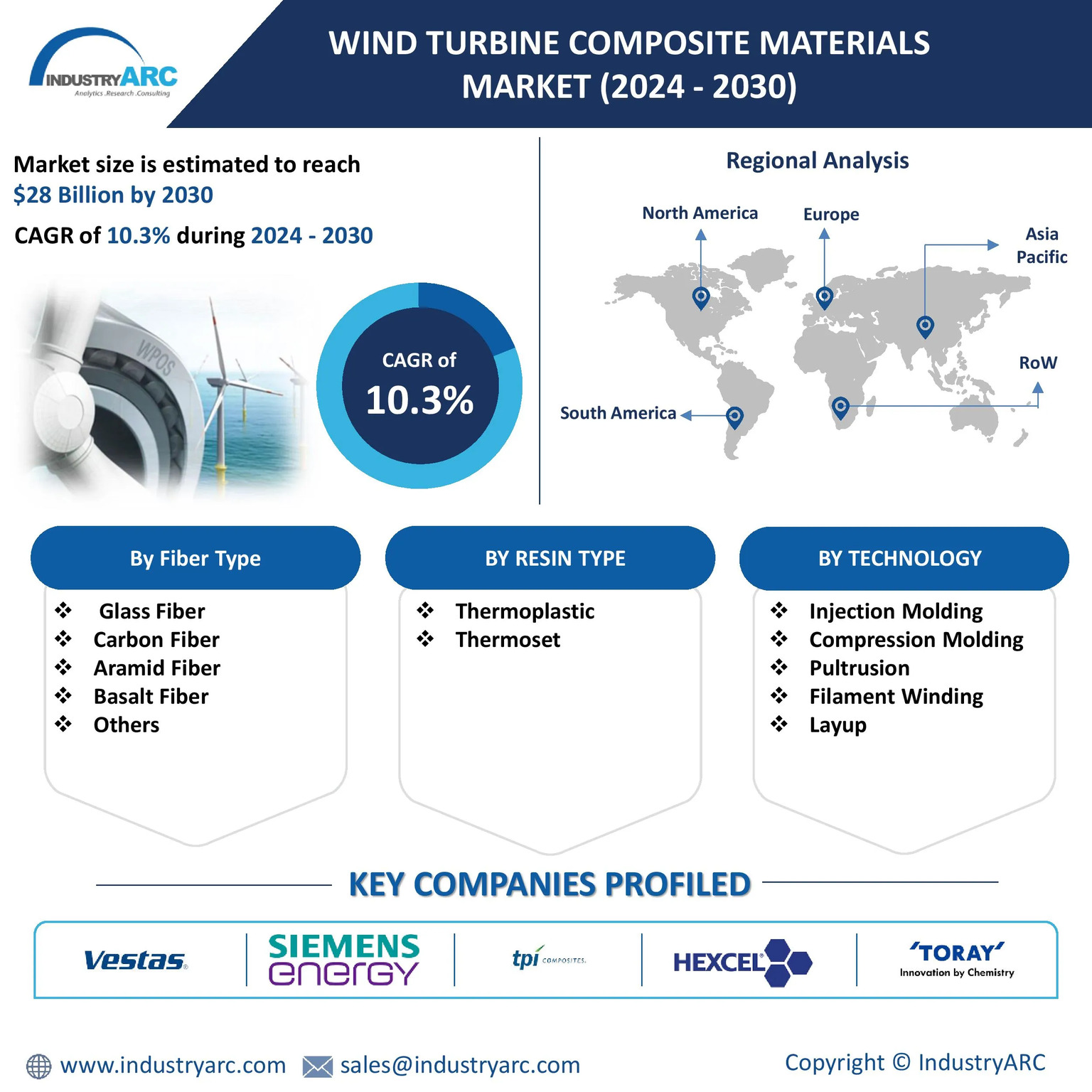
Wind Turbine Composite Materials Report Coverage
The report "Wind Turbine Composite Materials Market Report – Forecast (2024-2030)" by IndustryARC covers an in-depth analysis of the following segments of the Wind Turbine Composite Materials Market.
COVID-19 / Ukraine Crisis - Impact Analysis:
- The Wind Turbine Composite Materials industry witnessed a low demand for during the COVID 19 pandemic. Most manufacturing plants were closed down due to the pandemic as only essential services were permitted to run. Additionally, as governments focused on healthcare spending, renewable projects took a backseat which reduced the demand for composite materials.
- The Russia-Ukraine war drastically affected the Wind Turbine Composite Materials market. The high energy prices due to inflation and sanctions on Russia led to very high manufacturing costs for composites especially in Europe which affected the market.
Key Takeaways
Glass Fiber is the Largest Segment
The predominant material in most wind turbines is glass fiber reinforced polymer, usually employing polyester or epoxy resin. This composite combines high strength and durability with lightweight, making it ideal for wind turbines. The easy availability and cost-effectiveness of glass fiber reinforced plastics is also a key factor propelling the demand for glass fiber composites in wind turbine manufacturing. In March 2023, the European Commission issued the Net Zero Industrial Action Plan (NZIA) with the aim of achieving at least a 40% adoption rate of clean energy technologies within the European Union by 2030. This plan encompasses eight strategic technologies including wind power. This would result in a demand increase of 160,200 metric tons for glass fiber, which is required for the manufacturing of blades, nacelle covers and hub covers.
Blades are the Largest Segment
Blades occupy the largest market share in the wind turbine composite materials market. Turbine blades serve as the most important composite based part of wind turbines. The growing demand for wind energy is driving manufacturers to develop large wind blades for the high production of wind energy. For the development of large blades, a huge quantity of composite materials is used. All utility-scale wind turbine blades are manufactured using one form or another of reinforced polymer composites. But the industry is moving to the usage of carbon fiber over glass composites. As per TCI Composites, carbon fiber provides almost five-times the axial stiffness per kilogram of weight compared with fiberglass and can enable longer blades without increased rotor loads on the drive train and generator.
Europe Leads the Market
Europe occupies the largest market share in the Wind Turbine Composite Materials Market owing to the growth of clean energy. In Europe, wind generation is one of the leading sources of clean energy. According to WindEurope, Europe installed 18.3 GW of new wind power capacity in 2023. Europe is expected to install 260 GW of new wind power capacity over 2024-2030. Europe leads the world in wind energy, especially offshore wind, with over 90% of today's offshore wind farms. Rising renewable energy targets are accelerating plans for an offshore wind grid across northern Europe. Germany, the Netherlands, Belgium and Denmark pledged to install at least 65 GW of offshore wind capacity in the North Sea by 2030 and 150 GW by 2050. As efficient and clean wind generation requires the high specific strength and high specific modulus of elasticity of carbon fiber, more carbon fiber is being used per windmill. Therefore, as wind energy continues to grow in the region, the use of composites is also forecasted to increase.
Rising Demand for Renewable Energy Drives the Market
Renewable energy is at the forefront of the energy policy of all major economies. The European Commission has proposed raising the renewable energy target to 40% by 2030. The past few years have seen high growth rates in the wind energy sector. According to U.S. Department of Energy, U.S. wind capacity increased steadily over the last several years, more than tripling from 47.0 GW in 2010 to 147.5 GW at the end of 2023. Composite materials, such as fiberglass and carbon fiber play a critical role in manufacturing lightweight yet durable turbine blades enabling higher efficiency and lower operational costs. These materials are crucial for designing larger blades which are essential for maximizing energy output in both onshore and offshore installations.
Use of Cheaper Alternatives to Hamper the Market
The availability of alternatives such as steel and aluminum poses a challenge to the wind turbine composite materials market. These traditional materials are widely used in turbine components like towers and nacelles due to their established manufacturing processes and cost advantages. While composites offer superior strength-to-weight ratios and corrosion resistance their higher production costs can deter adoption in price-sensitive markets. Additionally, the infrastructure and expertise required for composite material production are less developed compared to conventional materials further limiting their penetration.

For more details on this report - Request for Sample
Wind Turbine Composite Materials Industry Outlook
Technology launches, acquisitions, and R&D activities are key strategies adopted by players in the Wind Turbine Composite Materials Market. Global Wind Turbine Composite Materials top 10 companies include:
- Vestas Wind Systems A/S
- Siemens Energy
- TPI Composites Inc.
- Hexcel Corporation Group
- Toray Industries
- Mitsubishi Chemical Carbon Fiber and Composites, Inc.
- Notus Composites
- Axiom Materials, Inc
- Gurit Services AG
- Suzlon Energy


Comments
Post a Comment