Power Substation Automation & Integration Market- By Module, By Communication ,By Type , By End-user By Stage & By Region - Forecast(2024 - 2030)
Market Size overview
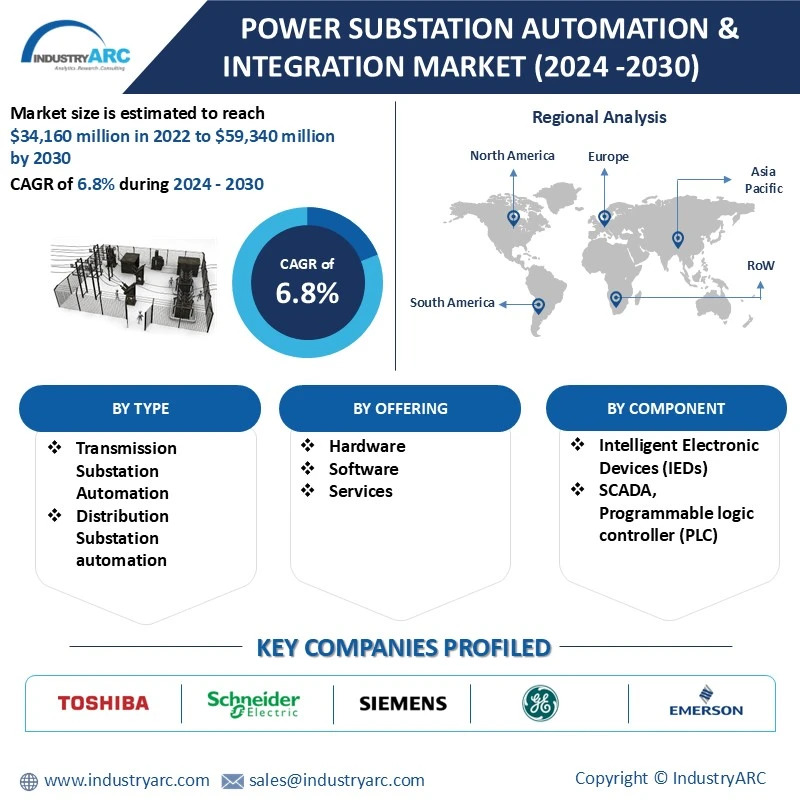
The Power Substation Automation & Integration market is poised for significant growth, projected to increase from $34,160 million in 2022 to $59,340 million by 2030, at a compound annual growth rate (CAGR) of 6.8% from 2024 to 2030. This growth is driven by the rising adoption of smart grid technologies, increased investments in renewable energy, and the need to upgrade aging infrastructure. For instance, the International Energy Agency (IEA) reported that global investments in smart grid technologies, including substation automation, reached approximately $290 billion in 2022, a 9% increase from the previous year. The market is segmented into transmission substation automation, distribution substation automation, and collector/tie line substation automation, with transmission substation automation being the largest segment, projected to grow at a CAGR of 7.1%. Asia-Pacific is expected to be the fastest-growing region, fueled by rapid industrialization and urbanization, particularly in countries like China and India. Technological advancements, such as the integration of IoT and AI, are further propelling market growth. However, challenges such as high initial investment costs and cybersecurity concerns could potentially hinder market expansion.
Market Snapshot
Market Trends
The integration of Internet of Things (IoT) and Artificial Intelligence (AI) technologies is a prominent trend in the Power Substation Automation & Integration market. IoT enhances real-time monitoring and control by connecting various substation components and systems, allowing for seamless data exchange and improved operational efficiency. AI further optimizes this integration by providing predictive analytics, fault detection, and automated decision-making processes. This combination enables utilities to better manage energy flow, predict maintenance needs, and reduce operational costs. For instance, AI algorithms can analyze historical data to predict potential failures, allowing for proactive maintenance rather than reactive fixes. According to a recent market report, the deployment of IoT and AI in substations is expected to drive substantial growth, improving grid reliability and reducing downtime. This trend is particularly significant as utilities strive to modernize infrastructure and enhance resilience against grid disruptions.
Report Coverage
The report: “Power Substation Automation & Integration Market – Forecast (2024-2030)” by IndustryARC, covers an in-depth analysis of the following segments in the Power Substation Automation & Integration market.
By Type: Transmission Substation Automation, Distribution Substation automation, Collector/tie line substation automation.
By Offering: Hardware, Software, Services.
By Component: Intelligent Electronic Devices (IEDs), SCADA, Programmable logic controller (PLC), Communication Network Technology, Others.
By Stage: Retrofit, New Construction.
By Deployment Cost: Less than $0.5m, $0.5m-$1m, $1m-$2m, $2m-$5m, more than $5m.
By End-use Industry: Utilities Sector, Oil and Gas Industry, Chemical Industries, Commercial buildings, Mining & Metal Industry, Data Center, Power Generation, Transportation, Government & Public Sector, Telecom, Healthcare, Educational Institutions, Agriculture, Others.
Key Takeaways
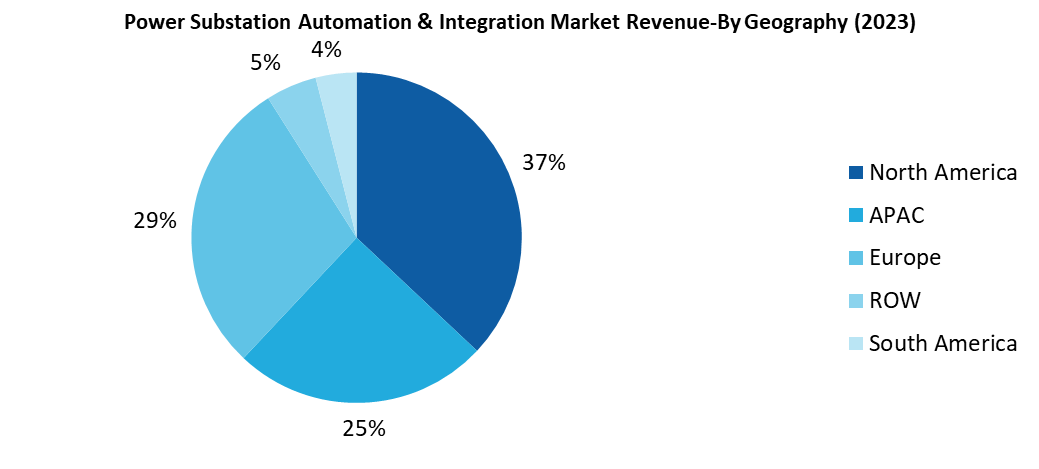
- As of 2024, North America dominates the Power Substation Automation & Integration Market, holding the highest regional share at approximately 37%, with projected revenues of $14,833.0 million. This leadership is attributed to significant advancements in grid modernization and substantial investments in renewable energy integration.
- The Asia-Pacific region, driven by countries like China and India, is showing strong growth potential, with projected revenues reaching $13,275.3 million in 2024. This region is anticipated to achieve the highest CAGR of 7.8% from 2024 to 2030, fueled by rapid urbanization, industrialization, and increasing energy demand.
- Europe continues to play a significant role in the market, with consistent investments in smart grid technologies and renewable energy driving steady growth. The region remains a key contributor to the global market expansion, following closely behind North America in market performance.
Power Substation Automation & Integration Market Segmentation Analysis - By Type
The market is divided into transmission, distribution, and collector/tie line substation automation. Transmission substation automation leads the market, with projections indicating it will reach $31,760 million by 2030, growing at a 7.1% CAGR. This segment's dominance is supported by the growing need to enhance the efficiency and reliability of high-voltage power transmission networks. According to a 2023 report by the U.S. Department of Energy, approximately 70% of the U.S. transmission lines are over 25 years old, necessitating upgrades and automation.
Power Substation Automation & Integration Market Segmentation Analysis - By Offering
The market offerings include hardware, software, and services. Hardware continues to dominate, driven by the demand for Remote Terminal Units (RTUs), routers, and switches, which are essential for the operational functionality of automated substations. Hardware is expected to grow at a 6.2% CAGR. Software solutions, such as Energy Management Systems (EMS) and Distribution Management Systems (DMS), are gaining traction due to their role in optimizing grid operations and enhancing decision-making capabilities. The software segment is growing at a 7.4% CAGR. Services, including consulting, maintenance, and system integration, are becoming increasingly critical, with a 7.5% CAGR, as utilities and industries require continuous support and optimization of their automated systems.
Power Substation Automation & Integration Market Segmentation Analysis - By Component
Intelligent Electronic Devices (IEDs) and SCADA (Supervisory Control and Data Acquisition) systems are the backbone of substation automation, with IEDs leading the segment at a 5.9% CAGR. The increasing deployment of communication network technologies, particularly Ethernet and wireless solutions, is driving rapid growth in this segment, projected at an 8.0% CAGR. Real-time data communication and control are becoming essential as substations become more complex and interconnected.
Power Substation Automation & Integration Market Segmentation Analysis - By Deployment Cost
Substations with deployment costs less than $0.5 million and those between $0.5 million to $1 million are key market segments, growing at 7.7% and 6.7% CAGRs, respectively. These segments highlight the market's focus on providing cost-effective automation solutions, especially for smaller and medium-scale projects. According to a 2023 report by the International Energy Agency (IEA), investments in cost-effective grid modernization solutions, including substation automation, are expected to increase by 15% annually over the next five years.
Power Substation Automation & Integration Market Segmentation Analysis - By Stage
Retrofit projects are a significant portion of the market, with a 6.1% CAGR, driven by the need to modernize existing infrastructure. For instance, the European Union allocated €45 billion in 2022 towards upgrading existing substations as part of its Green Deal. However, new construction projects are growing at a faster rate of 7.9% CAGR, indicating a strong demand for advanced, integrated automation systems in new substation builds.
Power Substation Automation & Integration Market Segmentation Analysis - By End-User
The utilities sector is the largest end-user segment, projected to reach $20750 Million by 2030 with a 5.5% CAGR. This reflects the sector's critical need for reliable and efficient power distribution. The oil and gas, chemical, and commercial building industries are also key contributors, with the commercial buildings segment exhibiting the highest growth at an 8.0% CAGR. This growth is driven by the increasing demand for energy-efficient buildings, supported by government incentives and regulations. According to a report by the U.S. Green Building Council (USGBC), energy-efficient building projects in the U.S. increased by 12% in 2023, further fueling demand in this market segment.
Power Substation Automation & Integration Market Segmentation Analysis - By Geography
The Power Substation Automation & Integration Market is segmented by geography into North America, Europe, Asia-Pacific, Latin America, and the Middle East & Africa. As of 2024, North America leads the market with a projected revenue of $14,833.0 million, driven by advancements in grid modernization and high investments in renewable energy integration. North America's market share is the highest among regions, accounting for approximately 37% of the total global revenue. Europe follows with significant investments in smart grid technologies and renewable energy, contributing to a steady market growth. The Asia-Pacific region, with countries like China and India, shows robust growth potential due to the increasing demand for energy and infrastructural developments, projected to reach $13,275.3 million in 2024. Latin America and the Middle East & Africa regions also exhibit growth, albeit at a slower pace, due to ongoing infrastructure development and modernization initiatives. By 2030, North America is expected to maintain its dominant position, but the Asia-Pacific region is anticipated to narrow the gap, driven by rapid urbanization and industrialization, reaching a CAGR of 7.8% from 2024 to 2030.
Market Drivers:
Rising Investments in Renewable Energy Integration
Rising investments in renewable energy integration are significantly driving the Power Substation Automation & Integration market. As the global energy landscape shifts towards more sustainable sources such as solar, wind, and hydro power, there is a pressing need to upgrade existing substations to handle the complexities associated with these variable energy sources. Substation automation facilitates the smooth integration of renewable energy by providing advanced control, monitoring, and optimization capabilities. It allows for better management of the intermittent nature of renewable sources, enhancing grid stability and reliability. The International Renewable Energy Agency (IRENA) reported a substantial increase in global investments in renewable energy, which reached over $400 billion in 2023. This surge in investment underscores the growing emphasis on incorporating renewable energy into the grid, driving the demand for advanced substation automation solutions that can accommodate these changes and support a more sustainable energy future.
Increasing Adoption of Smart Grid Technologies
The growing adoption of smart grid technologies is a major driver of the Power Substation Automation & Integration market. Smart grids leverage advanced technologies, including automation, communication systems, and data analytics, to enhance the efficiency, reliability, and flexibility of power distribution networks. By integrating automation into substations, utilities can achieve real-time monitoring, predictive maintenance, and automated fault detection and response. This enhances the overall performance of the grid, reduces downtime, and improves the reliability of power supply. According to a 2023 report by the International Energy Agency (IEA), global investments in smart grid technologies, which include substation automation, reached approximately $290 billion in 2022, reflecting a significant year-over-year increase. The continued push towards smart grid implementation is driven by the need to modernize aging infrastructure, integrate renewable energy sources, and respond to the growing demand for more resilient and adaptable power systems.
Market Challenges:
High Initial Investment and Implementation Costs
One of the significant challenges in the Power Substation Automation & Integration market is the high initial investment and implementation costs associated with upgrading and integrating automation systems. The deployment of advanced technologies such as IoT, AI, and smart grid components requires substantial capital expenditure, which includes the costs of new equipment, software, and the associated infrastructure. For many utilities, especially those in developing regions, these high costs can be a significant barrier to adoption. According to industry reports, the initial setup for modern substation automation systems can range from millions to billions of dollars, depending on the size and scope of the project. These costs can be prohibitive for smaller utilities or those with limited budgets, leading to delays or deferrals in necessary upgrades and impacting the overall pace of market growth.
Cybersecurity Risks and Data Privacy Concerns
Another critical challenge facing the Power Substation Automation & Integration market is the increasing risk of cybersecurity threats and data privacy concerns. As substations become more interconnected through digital technologies and smart grid solutions, they become more vulnerable to cyber-attacks. These attacks can disrupt operations, cause power outages, and compromise sensitive data. The integration of IoT devices and communication networks in substations amplifies these risks, as each connected device can be a potential entry point for cyber threats. According to recent cybersecurity studies, the frequency and sophistication of attacks on critical infrastructure, including power grids, have been rising. Utilities must invest in robust cybersecurity measures and protocols to protect their systems and data, adding to the overall cost and complexity of automation projects. Ensuring data privacy and maintaining system integrity in the face of evolving cyber threats remains a significant challenge for the industry.
Power Substation Automation & Integration Market Competitive Landscape
Product launches, acquisitions, market penetration, and R&D activities are key strategies adopted by players in the Electronic Access Control market. The top players in the Power Substation Automation & Integration market are:
- Emerson
- GE Vernova
- Siemens
- Schneider Electric
- Toshiba
- Mitsubishi Electric
- Eaton
- S&C Electric
- Rockwell Automation
- Honeywell International & Others
Recent Developments
- In September 2023, Siemens Energy acquired Coresystems, aiming to strengthen its position in substation automation and digital grid technologies, providing enhanced solutions for remote monitoring and predictive maintenance.
- In June 2023, ABB, a leading global technology company, acquired Envitec to enhance its portfolio in power substation automation, particularly focusing on improving the efficiency and reliability of electrical grids.

Comments
Post a Comment