Industrial Gas Turbine Market – By Fuel Type , By Capacity , By Technology , By Type , By End-Use Industry , By Geography - Opportunity Analysis & Industry Forecast, 2024-2030
Industrial Gas Turbine Market Overview:
The Industrial Gas Turbine Market size is estimated to reach $17.3 billion by 2030, growing at a CAGR of 7.6% during the forecast period 2024-2030. Industrial gas turbines are machines which convert the chemical energy stored in fuel into mechanical energy, and are used mainly for power generation and industrial uses. Demand for clean energy is growing and the turbines are running on natural gas, which emits fewer pollutants. Cogeneration systems are adopted to increase the adoption of turbines for efficient production of electricity and heat. Their use in powering compressors and pumps is boosted by expansion in the oil and gas sector. Turbine efficiency and reliability improve with technology, and urbanization and industrialization continue increasing stable energy demand. Cleaner energy policies supported by the government also drive the market.
Hydrogen as a fuel and high efficiency turbines are two key trends in the industrial gas turbines market. For example, the construction of a 600 MW hydrogen ready Combined Cycle Gas Turbine (CCGT) power plant at Pulau Seraya Power Station in Singapore commenced by YTL PowerSeraya with completion scheduled for December 2027, highlighting the growing use of Hydrogen as a fuel. Moreover, GE Vernova turbines, designed to handle 50 % hydrogen are being used in the project, which will cost $5.97 billion, in line with Singapore’s National Hydrogen Strategy to diversify its energy mix and meet net zero goals by 2050. In the meantime, advanced turbines like Mitsubishi Power’s JAC-Series are being developed with air cooled combustor technology that performs over 63% efficiency in combined cycle operation. The market is increasingly focused on energy solutions that are sustainable and high performance.
Market Snapshot:

Industrial Gas Turbine Market - Report Coverage:
The “Industrial Gas Turbine Market Report - Forecast (2024-2030)” by IndustryARC, covers an in-depth analysis of the following segments in the Industrial Gas Turbine Market.
COVID-19 / Ukraine Crisis - Impact Analysis:
- The industrial gas turbine market was significantly impacted by the COVID 19 pandemic, through a reduction in global energy demand. Gas demand in the U.S. power generation sector stagnated as utilities moved to renewables and retail integration. Small U.S. gas producers saw their financial conditions deteriorate further, with profitability, liquidity and refinancing capacity being squeezed. Despite the phasing out of coal and nuclear energy in Europe, the Green Deal limited long term natural gas support, creating uncertainty about its future role.
- The Russia Ukraine war added to the woes of the industrial gas turbine market by interrupting global supply chain and shifting the technological requirements. Sanctions against Russia caused European gas producers to seek new markets in Asia, and to pay more attention to green energy solutions.
Key Takeaways:
North America is the Leading Region
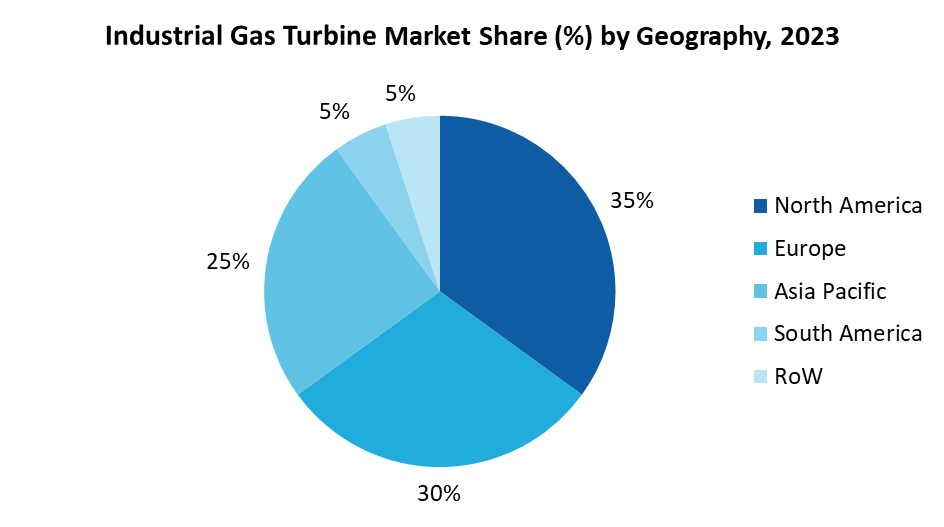
North America is projected as the leading region in Industrial Gas Turbine Market with market share of 35% during the period of 2023. North America stands as the largest region in the industrial gas turbine market primarily due to the extensive adoption of advanced energy solutions like cogeneration systems. As per the Architect of the Capitol (AOC), cogeneration is the best way to accomplish significant energy savings, minimise environmental impact and guarantee a dependable supply of chilled water and steam for crucial facilities like the U.S. Capitol and the Supreme Court. This technology, which produces electricity and heat simultaneously from a single natural gas source, has more than 4,400 cogeneration facilities across the United States. Moreover, North America's abundance of shale gas resources facilitates the coal to natural gas-based power generation, consistent with both economic and environmental goals. In addition, cogeneration complies with government and industrial demands to decrease greenhouse gas emissions and encourage green energy approaches.
Oil & Gas Dominate the Market
The industrial gas turbine market is dominated by the Oil & Gas sector, in terms of end use industry, because of its high usage of gas turbines in upstream, midstream and downstream applications. As per Siemens, gas turbines are used for power generation and mechanical drive operations such as compressors and pumps. These have been consistently demonstrated to be of exceptional reliability in critical applications such as oil and gas production and processing, pipeline transportation, LNG facilities and refineries. With natural gas becoming more important to the global energy mix, demand for gas turbines in oil and gas applications is expected to remain strong. By 2050, oil and natural gas will continue to play a vital role in industry, providing the high heat required for manufacturing processes and serving as key feedstocks for chemical production, as noted by Exxon Mobil. The indispensability of these turbines to the sector is due to their ability to provide efficient and reliable energy solutions for refining, pipeline transportation and LNG production. Gas turbine performance and adaptability are proven and are a key to the ability of this important industry to sustain operations and meet energy demands.
Aeroderivative Gas Turbines Show Fastest Growth
With their unmatched adaptability, efficiency and operational advantages, aeroderivative gas turbines are the fastest growing segment of the industrial gas turbine market. According to GE Vernova, these turbines deliver unparalleled environmental advantages, generating low emissions that support global decarbonization efforts. They are compact, modular and can be installed in as little as three months, with applications in industries that require fast deployment. Aeroderivatives are characterised by operational flexibility and the capacity to meet variable loads without sacrificing fuel economy. Features such as easy mobilisation reduce the transportation and reallocation costs, while their lightweight frame and smaller energy footprint allows them to be installed in space constrained environments. So, they work with different kinds of fuel like natural gas, diesel and ethanol contributing to reduce the operational expense. They have high reliability, over 98% availability and limited maintenance requirements, once a year, which makes them a cost-effective solution for peak power and emergency applications. For instance, the Whyalla hydrogen power plant will deliver 200 MW using GE Vernova's 100% hydrogen-fueled turbines, enhancing grid stability and supporting renewable energy integration. This power plant is set to operate by 2026. This project underscores the pivotal role of aeroderivative gas turbines in accelerating the transition to a renewable energy future while maintaining grid reliability.
Rising Demand for Clean Energy Drives the Market
One of the major drivers for the growth of the Industrial Gas Turbines Market is the escalating demand for clean energy as governments and industries focus on cutting greenhouse gas emissions and shifting to renewable energy. In 2022, renewable energy comprised 22.5% of the EU's final energy consumption, and the EU's greenhouse gas emissions were down 30% compared with 1990 levels, according to the European Energy Agency. The European Green Deal and REPowerEU Plan push for rapid growth of renewables and a new target of 45% renewables by 2030. This transition is supported by industrial gas turbines providing a reliable and consistent energy supply at times of fluctuating renewable generation, and maintaining grid stability. Industrial gas turbines are key to meeting the challenge of balancing rising energy demands while pushing the industry towards climate neutrality by 2050, as nations around the globe strive to achieve this goal.
Thermal Stress to Hamper the Growth
In the Industrial Gas Turbines Market, one of the main challenges is the very high temperatures that are created during operation, particularly in combined cycle power plants. Thermal stress and material/component life are reduced due to the combination chambers operating at temperatures up to 1700°C. In regions with high ambient temperature, turbine efficiency and power output are reduced even further, as per ARANER. For example, the same gas turbine will produce about 15% more electricity at 0°C ambient temperature than at 30°C. The importance of this reduction in performance during peak power demand periods is also highlighted during high ambient temperatures, such as during summer cooling demand. The costs and operation of these systems are driven up and complicated by the effort and design considerations necessary to overcome these challenges.
For more details on this report - Request for Sample
Key Market Players:
Product/Service launches, approvals, patents and events, acquisitions, partnerships, and collaborations are key strategies adopted by players in the Industrial Gas Turbine Market. The top 10 companies in this industry are listed below:
- Siemens Ltd
- GE Vernova
- Mitsubishi Hitachi Power Systems
- Kawasaki Heavy Industries, Ltd.
- Bharat Heavy Electricals Ltd. (BHEL)
- Vericor Power Systems Llc
- Solar Turbines Incorporated
- Ansaldo Energia S.p.A
- MTU Aero engines
- Bomco Inc

Comments
Post a Comment